

Worth knowing first: this corner of Ottawa was a market before it was a place to eat out. What follows is a short history of dining in ByWard Market, written from published sources. Where the sources give different dates we say so, and where we could not find a reliable record we would rather leave a gap than fill it.
A cedar bog and a canal
According to Heritage Ottawa, in 1827 Lieutenant-Colonel John By drained and cleared a dense cedar bog to create a commercial district for the Rideau Canal workers, and the market grew from that. Wikipedia’s entry on Lower Town, the neighbourhood around the market, says workers hired to build the canal arrived from 1826. French-Canadian immigrants mostly worked in the timber trade and Irish immigrants on the canal; both groups were Catholic. In the decades after, Jewish residents and Italian immigrants joined them.
The first market halls
A local history blog says By used rents from Lower Town properties to build a wooden market on George Street, with a porch, serving as marketplace and public hall; it was taken down in the early 1840s. On 4 November 1848 the newly incorporated Town of Bytown opened a two-storey wooden market on the same street, the Lower Town Market: butchers on the ground floor, and upstairs the French-Canadian Institute, founded in 1852, with a reading room. Residents could buy live poultry, vegetables and fruit, dairy, berries and, in season, maple syrup.
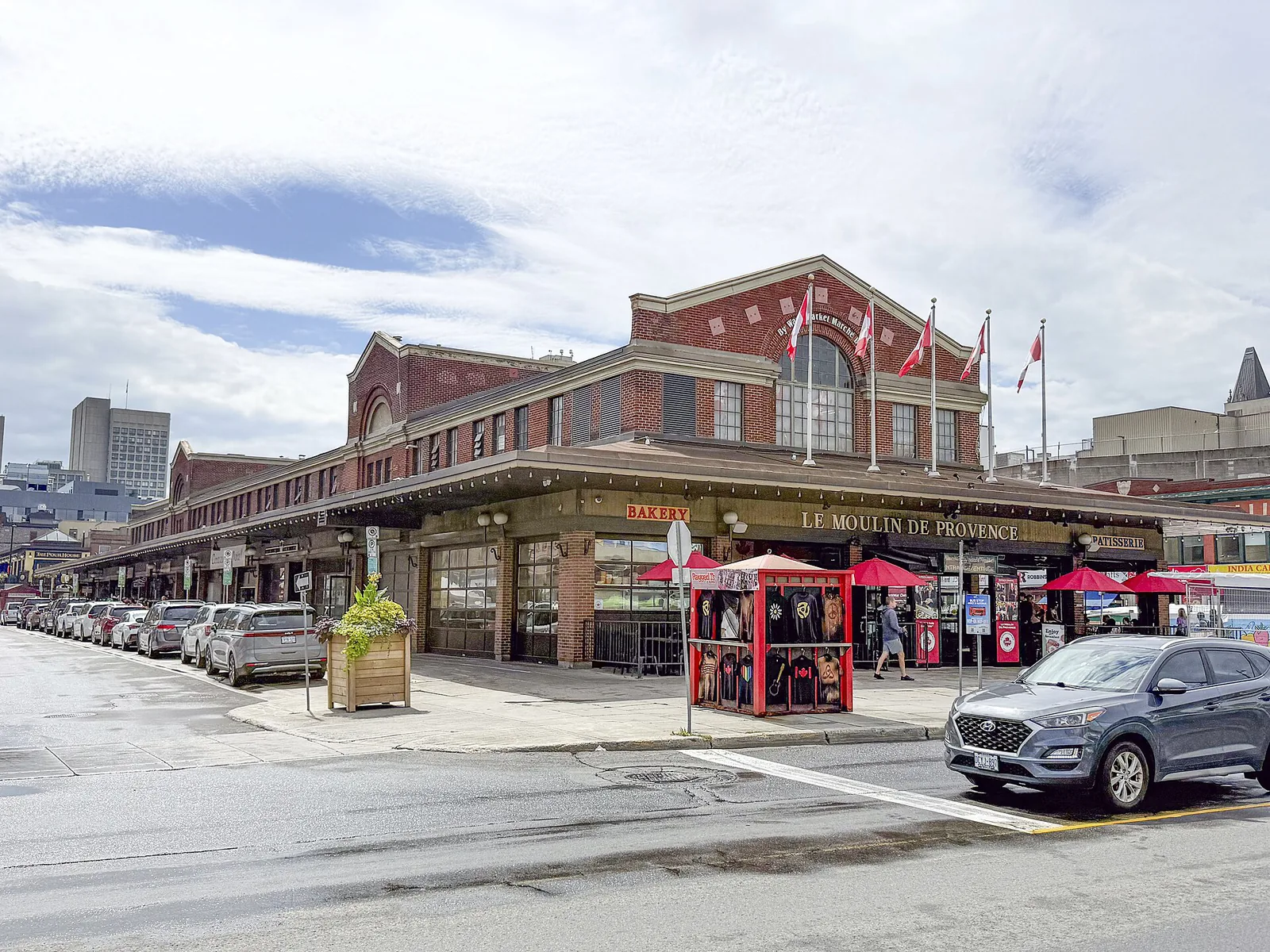
Heritage Ottawa dates the first market building to about 1846, on the George Street line, so the sources differ by roughly two years. A fire destroyed that building in January 1862. The blog says it was rebuilt in 1864; Heritage Ottawa says a new market building went up on William Street in 1865, followed in 1875 by the Lower Town Market designed by James Mather. That building burned in 1926, and today’s ByWard Market Building, designed by Richards and Abra, was completed in 1928.
And the restaurants?
We looked for a reliable listing of restaurants around the market before the twentieth century and did not find one, so we will not invent it. What the sources do show is what people who lived and traded here ate: poultry, butchers’ meat, vegetables, fruit, maple syrup, and the city that grew up around them.
One thread we can follow is Chinese food in Ottawa. Simon Fraser University’s history of Ottawa’s Chinatown says the city’s Chinese population was about 170 in 1911. By 1931 a small Chinatown on Albert Street had three grocery stores, two laundries, two clubs and a gift shop; by 1941 twelve shops, four of them restaurants. From the late 1960s merchants moved to Somerset Street West, and by 1974 it had Wah Fatt Barbecue Shop and Grocery, China Restaurant and Shanghai Restaurant, among others.
A beaver tail, a canal and a president
In 1978 Grant and Pam Hooker sold a family recipe of fried dough at a craft fair in Killaloe, in the Ottawa Valley. According to the BeaverTails website, on 2 June 1980 they opened the first permanent stand, a 15-foot-square wooden hut in ByWard Market, and from 1981 they also sold on the frozen Rideau Canal. Wikipedia records that in February 2009 President Obama bought a BeaverTail and maple-leaf cookies here.

Keeping the market
Heritage Ottawa records that City Council adopted a protection strategy for the area on 20 February 1980. On 6 February 1991 Council voted unanimously to create the ByWard Market Heritage Conservation District, covering 50 acres, 15 blocks and 160 buildings. Wikipedia says the four blocks around the market hold the densest concentration of restaurants, bars and nightclubs in the National Capital Region.
Where we are
In June 2022 Peking Duck opened on the second floor of 90 George Street. By Heritage Ottawa’s account, the first market building of about 1846 stood on the same street. There is a small echo from Beijing too. Quanjude’s founder, the poultry dealer Yang Quanren, took over a failing shop on the meat-market street at Qianmen in 1864 and made it Quanjude: a market street in Beijing, a market street in Ottawa, a century and a half apart, and in the end a duck restaurant on each.
We cannot claim a long history in the market: we arrived in 2022. But we are glad to be part of a street that has been feeding people for almost two hundred years.
Sources: Heritage Ottawa — ByWard Market Heritage Conservation District · Today in Ottawa’s History — Byward Market · Wikipedia — ByWard Market · Wikipedia — Lower Town · Simon Fraser University — Ottawa Chinatown · BeaverTails — about us